teena

teena
my baby girl

Tuesday, 5 June 2012

info i found on line dissecting a frog --address---http://www.biologyjunction.com/frog_dissection.htm


Frog DissectionPictures:  Modern Biology, Holt
Background:As members of the class Amphibia, frogs may live some of their adult lives on land, but they must return to water to reproduce. Eggs are laid and fertilized in water. On the outside of the frog’s head are two external nares, or nostrils; two tympani, or eardrums; and two eyes, each of which has three lids. The third lid, called the nictitating membrane, is transparent. Inside the mouth are two internal nares, or openings into the nostrils; two vomerine teeth in the middle of the roof of the mouth; and two maxillary teeth at the sides of the mouth. Also inside the mouth behind the tongue is the pharynx, or throat. 
In the pharynx, there are several openings: one into the esophagus, the tube into which food is swallowed; one into the glottis, through which air enters the larynx, or voice box; and two into the Eustachian tubes, which connect the pharynx to the ear. The digestive system consists of the organs of the digestive tract, or food tube, and the digestive glands. From the esophagus, swallowed food moves into the stomach and then into the small intestineBile is a digestive juice made by the liver and stored in the gallbladder. Bile flows into a tube called the common bile duct, into which pancreatic juice, a digestive juice from the pancreas, also flows. The contents of the common bile duct flow into the small intestine, where most of the digestion and absorption of food into the bloodstream takes place.
 Indigestible materials pass through the large intestine and then into the cloaca, the common exit chamber of the digestive, excretory, and reproductive systems. The respiratory system consists of the nostrils and the larynx, which opens into two lungs, hollow sacs with thin walls. The walls of the lungs are filled withcapillaries, which are microscopic blood vessels through which materials pass into and out of the blood. The circulatory system consists of the heart, blood vessels, and blood. The heart has two receiving chambers, or atria, and one sending chamber, or ventricle. Blood is carried to the heart in vessels called veins. Veins from different parts of the body enter the right and left atria. Blood from both atria goes into the ventricle and then is pumped into the arteries, which are blood vessels that carry blood away from the heart. 
The urinary system consists of the frog’s kidneys, ureters, bladder, and cloaca. The kidneys are organs that excrete urine. Connected to each kidney is aureter, a tube through which urine passes into the urinary bladder, a sac that stores urine until it passes out of the body through the cloaca. The organs of themale reproductive system are the testes, sperm ducts, and cloaca. Those of the female system are the ovaries, oviducts, uteri, and cloaca. The testes produce sperm, or male sex cells, which move through sperm ducts, tubes that carry sperm into the cloaca, from which the sperm move outside the body. Theovaries produce eggs, or female sex cells, which move through oviducts into the uteri, then through the cloaca outside the body.
The central nervous system of the frog consists of  the brain, which is enclosed in the skull, and the spinal cord, which is enclosed in the backboneNervesbranch out from the spinal cord. The frog’s skeletal and muscular systems consist of its framework of bones and joints, to which nearly all the voluntary muscles of the body  are attached. Voluntary muscles, which are those over which the frog has control, occur in pairs of flexors and extensors. When a flexor of a leg or other body part contracts, that  part is bent. When the extensor of that body part contracts, the part straightens. 
Objectives:• Describe the appearance of various organs found in the frog.
• Name the organs that make up various systems of the frog.
Purpose:In this lab, you will dissect a frog in order to observe the external and internal structures of frog anatomy.
Materials:• safety goggles, gloves, and a lab apron
• forceps
• preserved frog
• dissecting pins (6–10)
• dissecting tray and paper towels
• plastic storage bag and twist tie
• scissors
• marking pen
• dissecting needle
Procedure
  1. Put on safety goggles, gloves, and a lab apron.      
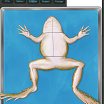
  2. Place a frog on a dissection tray. To determine the frog’s sex, look at the hand digits, or fingers, on its forelegs. A male frog usually has thick pads on its "thumbs," which is one external difference between the sexes, as shown in the diagram below. Male frogs are also usually smaller than female frogs. Observe several frogs to see the difference between males and females.
  1.  Use the diagram below to locate and identify the external features of the head. Find the mouthexternal nares, tympani, eyes, and nictitating membranes.
  1. Turn the frog on its back and pin down the legs. Cut the hinges of the mouth and open it wide. Use the diagram below to locate and identify the structures inside the mouth. Use a probe to help find each part: the vomerine teeth, the maxillary teeth, the internal nares, the tongue, the openings to the Eustachian tubes, the esophagus, the pharynx, and the slit-like glottis.
  1. Look for the opening to the frog’s cloaca, located between the hind legs. Use forceps to lift the skin and use scissors to cut along the center of the body from the cloaca to the lip. Turn back the skin, cut toward the side at each leg, and pin the skin flat. The diagram above shows how to make these cuts
  2. Lift and cut through the muscles and breast bone to open up the body cavity. If your frog is a female, the abdominal cavity may be filled with dark-colored eggs. If so, remove the eggs on one side so you can see the organs underlying them.
  3. Use the diagram below to locate and identify the organs of the digestive system: esophagus, stomach, small intestine, large intestine, cloaca, liver, gallbladder, and pancreas.

  1. Again refer to the diagram below to identify the parts of the circulatory and respiratory systems that are in the chest cavity. Find the left atrium, right atrium, and ventricle of the heart. Find an artery attached to the heart and another artery near the backbone. Find a vein near one of the shoulders. Find the two lungs.
  1. Use a probe and scissors to lift and remove the intestines and liver. Use the diagram on the next page to identify the parts of the urinary and reproductive systems. Remove the peritoneal membrane, which is connective tissue that lies on top of the red kidneys. Observe the yellow fat bodies that are attached to the kidneys. Find the ureters; the urinary bladder; the testes and sperm ducts in the male; and the ovaries, oviductsand uteri in the female.
  1. Remove the kidneys and look for threadlike spinal nerves that extend from the spinal cord. Dissect a thigh, and trace one nerve into a leg muscle. Note the size and texture of the leg muscles.
  2. Dispose of your materials according to the directions from your teacher.
  3. Clean up your work area and wash your hands before leaving the lab.
Click here for worksheet

dissection a frog


when my bio teacher Ian stated we had to dissect a frog ,my heart went up in my throat,im thinking how can i cut a little frog open,and how can i not show im actually scared of those little frogs[ya thats right im scared of them].But then he said it would be on an ipad ,i actually wouldnt be touching a real frog .i felt a little better but still wasnt to sure about dissecting a living thing,what about all the blood .But wants he showed us and i got to play around with thje ipad and the frog it was nothing like i exspected,no blood n the frog never got hurt.It was kind of neat to see inside a frog,see different parts of what a frog has for organs.It explained to you how to pin a frog down,the proper way of cutting the frog open so you do not destroy his organs,it explained to you the difference in frog and man.So Ian im glad you made us dissect a little frog,and you were right it wasnt what i thought it would be[lots of blood]


Monday, 21 May 2012

sprout

monday april 23/12 plants sprouted

cucumbers 7cm
music box 5cm --seed still on top
fashion mix 4cm
nasturtiums 2cm
radish 8cm

plant date

on april 17/12 planted seeds
1]wisconsin pickling cucs
-space 3"
-depth 1/2 -1"
-sprout 7-14
pick at 4" long

2]fashion mix-sunflower
-depth 8-10 cm
-space 1/4 - 1/2
-hight 1.5 m

3]music box-sunflower
-depth 1/2
-space  6"
-height 28"

4]french breakfast -radish
-depth 1/2
-space 1/2

5]nasturtium
-depth 1/2"
-space 2'"
-height 8"


Sunday, 15 April 2012

change of mind

as of thursday april 12,i changed my mind about what seeds i want to plant.im now gonna plant 

radish-----french breakfast
sunflower----colour fashion mix
sunflower----music box mix
cucumbers----wisconsin pickling
nasturtium-----alaska mixture
tomatoes------cherry

will follow up on info on planting

Wednesday, 4 April 2012

info on vessey seeds

vessey seeds are suppose to be the best seeds to buy and grow

info on vessey seeds--------https://www.veseys.com/ca/en/store/organicseed

Veseys is located in York, Prince Edward Island, only a ten minute drive from the Island's capital of Charlottetown. Head east from Charlottetown on Route 2, then north on Route 25.
Our civic address is 411 York Road, Highway 25, York, Prince Edward Island C0A 1P0.

Garden Gate Gift Shop Store Hours
  • Year Round 8:00 am – 5:00 pm
  • Except for: May-Jun we are open from 8:00 am – 8:00 pm
  • Every Saturday 8:00 am – 4:00 pm, we are closed on Sundays
  • *All times are Atlantic Standard Time
info on plants i picked to start my garden---------------

Ring of Fire Sunflower

Veseys Home » Store » Flower Seed » Sunflowers (A) » Cutting Sunflowers (A) » Ring of Fire Sunflower
Annual
Helianthus annuus
A very different sunflower. Ring of Fire is a 5" pollenless sunflower with bi-coloured petals with a dark red base and golden yellow tips surrounding a chocolate brown center. A late bloomer adding a fresh new look just when the garden needs it. Perfect for cutting. Height 4-5'. Approximately 20 seeds/Pkg.
Height:4′ - 5′
Colour:Yellow, Red, Orange
Light Requirements:
Attributes:
Item #DescriptionPriceQuantity
24850A
Pkg.
$3.50
24850X2
200 Seeds
$16.95
24850M1
1,000 Seeds
$38.95


Teddy Bear Sunflower

Veseys Home » Store » Flower Seed » Sunflowers (A) » Cutting Sunflowers (A) » Teddy Bear Sunflower
Annual
Helianthus annuus
Loads of bright orange multi-petaled chrysanthemum-type blooms. Dwarf sturdy plants are upright, growing about 3 feet tall. Teddy Bear is nice for cutting but equally nice for a colourful garden border. Approximately 125 seeds/Pkg.
Height:3′
Colour:Yellow
Light Requirements:
Attributes:
Item #DescriptionPriceQuantity
24670A
Pkg.
$2.25
24670G
10g
$4.20
24670H
25g
$8.45


Nasturtium Collection

Veseys Home » Store » Flower Seed » Nasturtium (A) » Nasturtium Collection
Save 20%!
Tropaeolum majus
Save!
A popular, easy-to-grow annual. This collection includes one package each of four varieties; Alaska Mix, Strawberry Cream, Empress of India and Whirlybird Mix.
Colour:Mixed
Light Requirements:
Attributes:
How to Grow: Nasturtium (A)
Item #DescriptionPriceQuantity
2328
4 Pkg Collection
$10.55

Alaska Mix Nasturtium

Veseys Home » Store » Flower Seed » Nasturtium (A) » Alaska Mix Nasturtium
Annual
Tropaeolum majus
A dwarf nasturtium with attractive and unique green and cream marbled foliage. Large, single blooms in five rich colours are held well above the foliage. Height 12 inches. Approximately 40-50 seeds/Pkg; 10 seeds/gram.
Height:12″
Colour:Mixed
Light Requirements:
Attributes:
How to Grow: Nasturtium (A)
Item #DescriptionPriceQuantity
23240A
Pkg
$2.50
23240H
25g
$8.50
23240J
125g
$19.95

Strawberry Cream Nasturtium

Veseys Home » Store » Flower Seed » Nasturtium (A) » Strawberry Cream Nasturtium
Annual
Tropaeolum majus
A combination of dark blue green foliage and bright green foliage is the first distinguishing characteristic that will draw you to this blend. Next, the strawberry red flowers coupled with rich cream flowers, sporting red marking, give this blend its name. This compact mounding type grows 10-12” high and 12-14” wide. Approximately 25 seeds/Pkg.
Height:10″ - 12″
Colour:Red, White
Light Requirements:
Attributes:
How to Grow: Nasturtium (A)
Item #DescriptionPriceQuantity
21720A
Pkg.
$3.95
21720X1
100 Seeds
$7.95
21720X5
500 Seeds
$26.95

Whirlybird Mix Nasturtium

Veseys Home » Store » Flower Seed » Nasturtium (A) » Whirlybird Mix Nasturtium
Annual
Tropaeolum majus
Whirlybird has large, spurless semi-double blooms in seven brilliant colours. Dwarf, compact and non-trailing. Blossoms sit well on top of foliage. Edible blossoms make colorful garnishes. Height 12 inches. Approximately 40-50 seeds/Pkg.; 10 seeds/gram.
Height:12″
Colour:Mixed
Light Requirements:
Attributes:
How to Grow: Nasturtium (A)
Item #DescriptionPriceQuantity
23220A
Pkg.
$2.95
23220H
25g
$9.55
23220J
125g
$26.95
23220L
500g
$69.95


Easter Egg Radish

Veseys Home » Store » Vegetable Seed » Radish » Round Red Radishes » Easter Egg Radish
Just as colourful as Easter eggs! Globe-shaped roots in a delightful array of pink, red, lavender, scarlet and white. The interior flesh is crispy and mild. Matures in 28 days. Easy to grow and fun for any age to try. Approxiamtely 400 seeds/Pkg.
Light Requirements:
How to Grow: Radish
Item #DescriptionPriceQuantity
18260A
Pkg.
$2.45
18260H
25g
$4.50
18260J
125g
$12.95
18260L
500g
$29.95


Cross Country Cucumber

Veseys Home » Store » Vegetable Seed » Cucumbers » Pickling Cucumbers » Cross Country Cucumber
Top quality hybrid pickling cucumber. Nice dark green skin with white spines and nicely shaped cucumbers. Resistant to diseases. High yielding under a variety of growing conditions. One of the most highly rated and widely used pickling cucumbers in the country. Maturity is about 51 - 53 days. Approximately 90 seeds/Pkg. Treated seed only.
Light Requirements:
How to Grow: Pickle Recipes, Cucumber
Item #DescriptionPriceQuantity
14330A
Pkg.
$2.95
14330X3
300 Seeds
$5.45
14330M1
1,000 Seeds
$10.95
14330M5
5,000 Seeds
$33.95
14330M15
15,000 Seeds
$84.95 each
5 or more: $79.95 each Save 6%


Window Box Roma Tomato

Veseys Home » Store » Vegetable Seed » Tomatoes » Paste Tomatoes » Window Box Roma Tomato
Designate a special pot and spot on your patio to grow this amazing Hybrid! Dwarf plants are very compact and quite ornamental even without fruit set. Bright red, elongated fruit, weighing 60-80 grams. Smooth and uniform in size and shape. Eating quality is incredible. Special breeding has created a sweet flavour and good holding ability on the plants. Plants will grow up to 1½ feet tall and are perfectly suited for container gardening. Maturity 70 days from transplanting. Approximately 25 seeds/Pkg.
Light Requirements:
How to Grow: Tomato Blight - Everything You Need To Know, Medium Hot Chili Recipe, Salsa Recipes, Tomato Starter Plants, Tomatoes
Item #DescriptionPriceQuantity
19210A
Pkg.